
Cherokee County Warrant Checks
Jurisdiction comes first in any Cherokee County warrant check. A county felony, a misdemeanor charged outside city limits, a District Court traffic case, and a Centre or Cedar Bluff municipal case each take their own route. Before you call anyone, gather the legal name, birth date, ticket or case number, issuing agency, and any known court date. The Sheriff warns that ordinary email is not secure, so keep those details off it. Match the channel to the matter. Online Traffic Resolution, or OTR, can pull up an eligible citation, while Just One Look and Alacourt supply trial-court case records under their own access models. None of them is a statewide public warrant registry. For a suspected county warrant, the local court's rule is plain: appear in person at the Sheriff's Department. If arrest, surrender, or bond worries you, a lawyer can help plan that contact safely.
- Read the citation, notice, or case paper to identify the issuing court and agency.
- For county court records, contact the Cherokee County Circuit Clerk or use the clerk-linked case-record service.
- For a traffic citation, check OTR with the ticket or case number and birth month and year.
- For Centre or Cedar Bluff matters, call that municipal court instead of assuming the county court holds it.
- For a suspected county arrest warrant, follow the court’s Sheriff visit instruction and consider legal advice first.
No Public Cherokee County Warrant Portal
Cherokee County publishes no official, public, name-searchable database of active warrants. That is a fact worth knowing, not a broken link. The Sheriff site offers a Most Wanted route and an inmate feature, yet neither is documented as a complete warrant list. A jail roster lists people already booked. A most-wanted page is a selected public-safety list, and a court case service shows case material. Different tools answer different questions. The Cherokee magistrates and warrants page tells anyone who suspects a warrant to appear at the Sheriff's Department, and it states that an unserved arrest warrant is not public. That local rule is why an empty online search can never clear a person. Calling the Sheriff's general line first makes sense when you need counsel or safe-arrival planning, though no official page promises phone confirmation of status.
Bottom line: No result in OTR, a court case service, the inmate roster, or Most Wanted proves that Cherokee County has no warrant.
Warrants in Cherokee County: The Main Types
What kind of warrant is it? The issuing event answers that. A complaint-based arrest warrant in Cherokee County follows a sworn report plus a magistrate's finding of probable cause. A missed-court warrant grows out of an existing case after someone skips a required appearance or another duty. Local sources use the terms warrant, failure to appear, failure to pay, and contempt of court. The label "capias pro fine" does not appear in Cherokee County materials.
| Warrant Type | How It Arises | Issuing Authority |
|---|---|---|
| Arrest warrant | A sworn complaint supports probable cause for arrest. | A judge or neutral magistrate |
| FTA or missed-court warrant | A required date or court duty is not met. | The court handling that case |
| Search warrant | Probable cause supports a search for specified evidence or property. | A judge or magistrate under separate rules |
| Indictment warrant | A grand-jury indictment leads to process commanding arrest and appearance. | Authorized Circuit Court officials |
A summons is a different animal. It orders a person to appear without an immediate arrest, since appearance alone may secure attendance. Ignore a Cherokee County summons, though, and a warrant problem can follow.
OTR Is Not a Warrant Search
Alabama OTR is built around a citation, not a name. You enter a ticket or case number plus your month and year of birth. When the case and court allow it, the service may offer defensive driving school, more time to pay, proof upload, a trial request, or a new court date. A past-date request may ask whether a license is suspended, whether an active warrant exists, or whether other cases remain open. None of that turns OTR into a general warrant database. The official Cherokee County traffic page lays out the citation and court route that leads to these limited resolution options, and the county interface it presents carries no private case details.
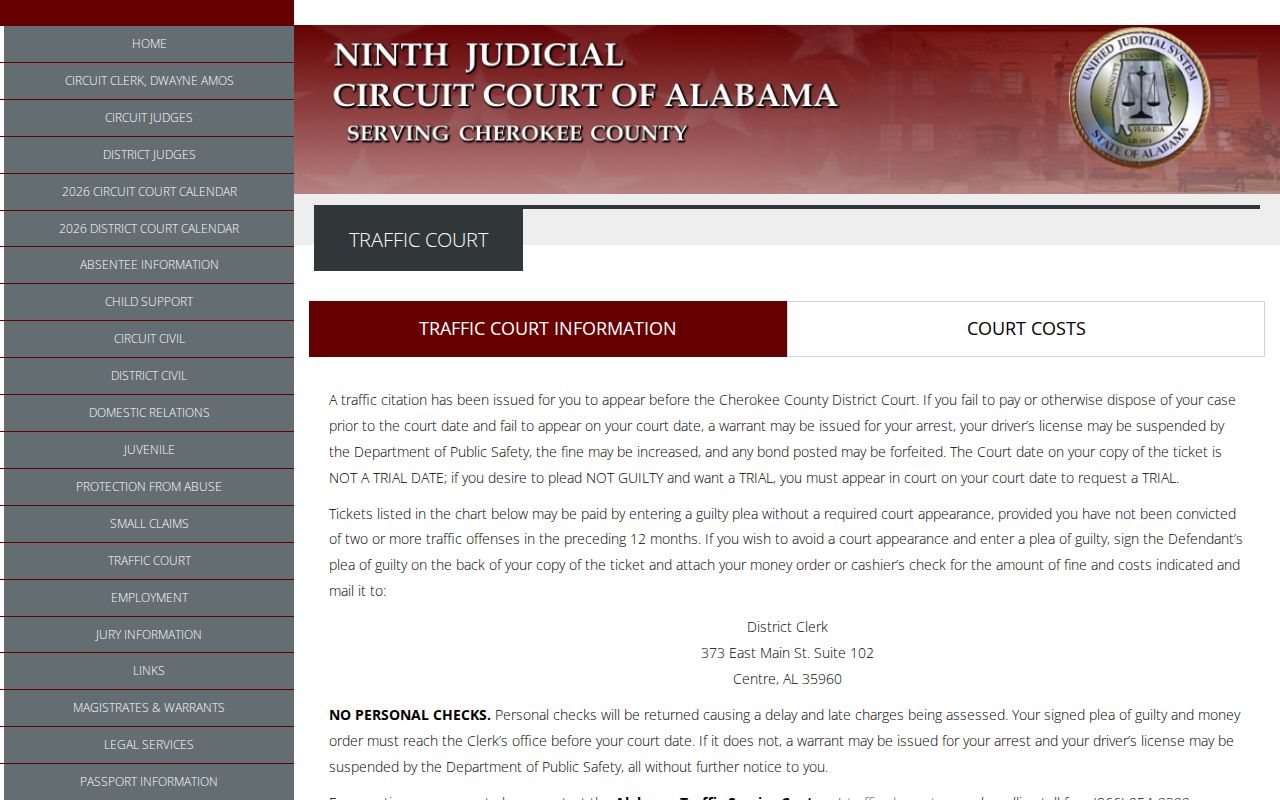
The county traffic page ties ticket payment and court options to one specific citation. It cannot confirm that a Cherokee County warrant is absent, served, or recalled.
| Identifier | Exact ticket number or case number |
|---|---|
| Birth field | Month and year of birth |
| Possible action | A court-dependent request, payment, proof upload, or trial option |
| Not provided | A public name search across all Cherokee County warrants |
Cherokee County Warrant Records: What They Show
Alabama Rule of Criminal Procedure 3.2 spells out the core legal contents of an arrest warrant. The document identifies the defendant with reasonable certainty, names the charged offense, commands arrest and appearance, and carries an authorized signature. When the offense is bailable, it may state release conditions too. A related Cherokee County court case can also hold a case number, filing date, division, hearing history, status, and disposition.
| Case or warrant identifier | A court-controlled reference, not a locally published sample format. Use the exact number on the paperwork, such as case number from notice. |
|---|---|
| Named person | The defendant’s name or another description that identifies the person with reasonable certainty. |
| Charge | The offense stated in the warrant or linked criminal case. |
| Issuing authority | The judge, magistrate, clerk, or other signer authorized for that stage. |
| Bond or release term | Recognizance or appearance-bond conditions when the court sets them. |
| Case status | Later case activity, hearings, service, or disposition where that information is public. |
Cherokee County publishes no sample warrant record. The fields above come from the rule and official case-process materials, not from any private person's record.
Unserved Cherokee County Warrants Stay Nonpublic
Cherokee County's own court notice says an arrest warrant is not a public record until it is served. That rule sharply limits what a public warrant-record request or online search can return. It also means a blank screen should never be read as a formal clearance, since a new or unserved matter may lawfully stay out of public view. Other limits exist as well. Juvenile court material, criminal-investigation files, sealed matters, and confidential data may all be closed. The Alabama Archives public-record FAQ explains that not every government record is open, and the Alabama Open Records Act, while it gives citizens access to public writings, does not erase these court and confidentiality boundaries.
- Unserved
- The warrant has not yet been executed; the local court says it is not yet public.
- Sealed
- A court has restricted public access to the record.
- FTA
- Failure to appear, the local label for missing a required court appearance.
- Recall or quash
- Court action that ends a warrant; Cherokee County does not publish one standard local form.
Cherokee County Warrants: Who Issues, Who Serves
Cherokee County sits in Alabama's Ninth Judicial Circuit. Circuit Court handles felony-level matters as the trial court of general jurisdiction, while District Court and warrant magistrates take the local district criminal, traffic, worthless-check, and complaint-stage work the county describes. Centre and Cedar Bluff municipal courts keep their own city cases. The Circuit Clerk maintains court records and divisions but does not give legal advice. Arrest process is carried out by the Sheriff and other peace officers. The official Sheriff contact page lists the office behind the courthouse and a 24-hour non-emergency number, useful details for the in-person route the court states.
Cherokee County Sheriff’s Office
110 Cedar Bluff Road
Centre, AL 35960
256-927-3365
Dispatch: 256-927-3939
Cherokee County Circuit Clerk
373 East Main Street, Suite 102
Centre, AL 35960
256-927-3637
Weekdays, 8 a.m. to 4 p.m., closed noon to 1 p.m.
From Report to Cherokee County Arrest Warrant
Every Cherokee County arrest warrant begins as paperwork, not handcuffs. It starts with a report. When the event happened in county jurisdiction, the Sheriff takes the incident or offense report. Inside a municipality, the city police department is the first stop. The complainant then carries the report into the warrant-magistrate process, swears an oath, and signs a deposition describing the alleged offense. A neutral magistrate weighs those sworn facts next. The question is probable cause, meaning enough facts to support a reasonable belief that the named offense occurred and that this person committed it. The magistrate acts as a judicial officer, never as an arm of the investigating officer. If the threshold is met, the warrant issues. Cherokee County charges nothing to obtain the warrant, though later court costs may follow and a charge is not simply withdrawn at will. The official magistrate page lays out that local process along with the Sheriff confirmation instruction.
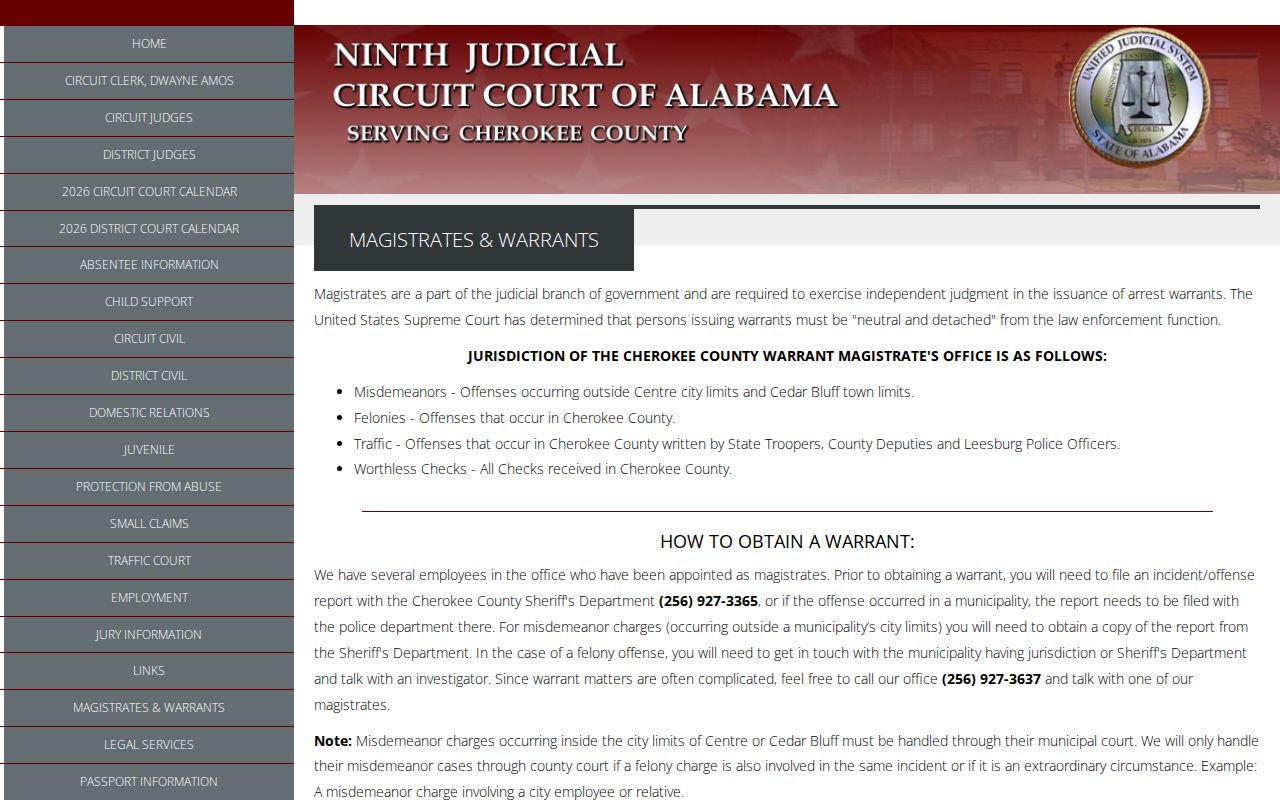
The full Cherokee County path runs from incident report to sworn deposition, probable-cause review, issuance, service, and finally the court case.
Handling a Cherokee County Warrant
An online payment does not end a warrant. Neither does a case-page update. First confirm the issuing court and the warrant's current status. Then ask what the court wants: an appearance, a surrender arrangement, bond, a fine payment, or a motion. A lawyer can chart the safest lawful route, especially when an arrest could happen without warning. The Circuit Clerk reports records and explains court procedure but cannot pick your legal strategy. Voluntary surrender means arranging an appearance rather than waiting on an unexpected arrest. Recall and quash are court actions that end a warrant. Because Cherokee County publishes no standard recall form, the issuing judge or counsel must direct that request. Bond gets a person out of custody. It does not dismiss the charge, and it does not close the case.
Important: Confirm the issuing court and seek legal advice before appearing on an active warrant or sending money to any payment channel.
Cherokee County Warrant Bond Paths
The Cherokee County Detention Center lists three bond paths: property, cash, or a licensed bonding company. A property bond takes two signers. Each signer needs unmortgaged property equal to the bond. A cash bond must be paid in full at the Circuit Clerk's Office or through the official cash-bond channel the jail links, using credit or debit card. Any bonding company must be licensed in Cherokee County. The detention facility's bond page carries the official restrictions. Bonds are processed seven days a week, with breaks from 5 to 7 a.m., 11 a.m. to 1 p.m., and 5 to 7 p.m. A zero-bond entry follows the court path the jail describes. It is not an ordinary online payment item.
| Bond Path | Local Requirement |
|---|---|
| Property | Two signers, each with enough unmortgaged property |
| Cash | Full payment through the Clerk or linked cash-bond channel |
| Bonding company | The company must be licensed in Cherokee County |
Note: Cherokee County publishes no general bond schedule, so the amount and release terms must be confirmed for the individual case.
Warrant Record Access Under Alabama Law
Alabama's Open Records Act, Ala. Code § 36-12-40, gives citizens access to public writings within lawful limits. It does not create a statewide warrant search. Nor does it make an unserved Cherokee County arrest warrant public. Send a request to the office that keeps the record. The Circuit Clerk holds court material, the Sheriff keeps available incident records, a city court has its own cases, and the County Commission controls writings in its custody.
Key rules:
Ala. Code § 36-12-40 provides access to public writings while preserving exceptions.
Alabama Criminal Rule 3.2 states the required contents and signing authority for an arrest warrant.
Alabama Criminal Rule 3.1 covers issuance of an arrest warrant or summons.
The County Commission keeps a separate 2024 policy. An Alabama resident must use its form, prove residency, and submit in person. Those fees and prepayment rules cover Commission records only. They do not override a court or Sheriff restriction in Cherokee County.
Cherokee County Traffic Warrant Consequences
Let an eligible citation go unresolved past its court date in Cherokee District Court, and four penalties follow: an arrest warrant may issue, the license may be suspended, the fine may increase, and posted bond may be forfeited. Forfeiture means losing the bond because the required court duty went unmet. The date printed on a ticket is an appearance date. It is not a trial date. Anyone who wants a trial must appear in court and request one. That distinction catches plenty of people off guard in Cherokee County.
That mix of courts is why citation compliance drives so much warrant activity in Cherokee County. Court dockets do not measure active warrants, though. Once a date has passed, call the Clerk. Ask the Traffic Service Center too whether a warrant, suspension notice, or reset is on file before paying anything. Even a resolved case may still need a Clerk-issued clearance notice delivered to ALEA.
City Warrant Records in Cherokee County
City warrant checks turn on the court named in the case. Centre and Cedar Bluff each run a documented municipal court. Those channels handle local traffic, misdemeanor, and ordinance matters. Leesburg falls under the county magistrate's traffic jurisdiction for qualifying citations written by Leesburg officers. Sand Rock crosses a county line. Its paperwork must be checked for the issuing county. Gaylesville offers no current municipal portal, so start any Cherokee County search by confirming which court issued the paperwork.
Centre Warrants
County seat with a separate municipal court and city payment channel.
Cedar Bluff Warrants
Municipal matters have a direct city-court telephone route.
Leesburg Warrants
Some police-issued traffic citations enter Cherokee District Court.
Sand Rock Warrants
The split-county location makes jurisdiction the first check.
Gaylesville Warrants
No current city portal was verified, so use the issuing court on the paperwork.
Cherokee County Clerk Warrant Records
Dwayne Amos serves as Circuit Clerk and the business manager for Cherokee County Circuit and District Courts. His office handles criminal, warrant, traffic, juvenile, domestic, child-support, and civil divisions. Not everything in those files is public. Still, the Clerk is the right office to ask for any Cherokee County court record that is available. Bring a case number if you have one. A broad request for every record under a name tends to slow things down. The official Circuit Clerk profile lays out the divisions and the office's record role, plus contact details for the Clerk's staff.
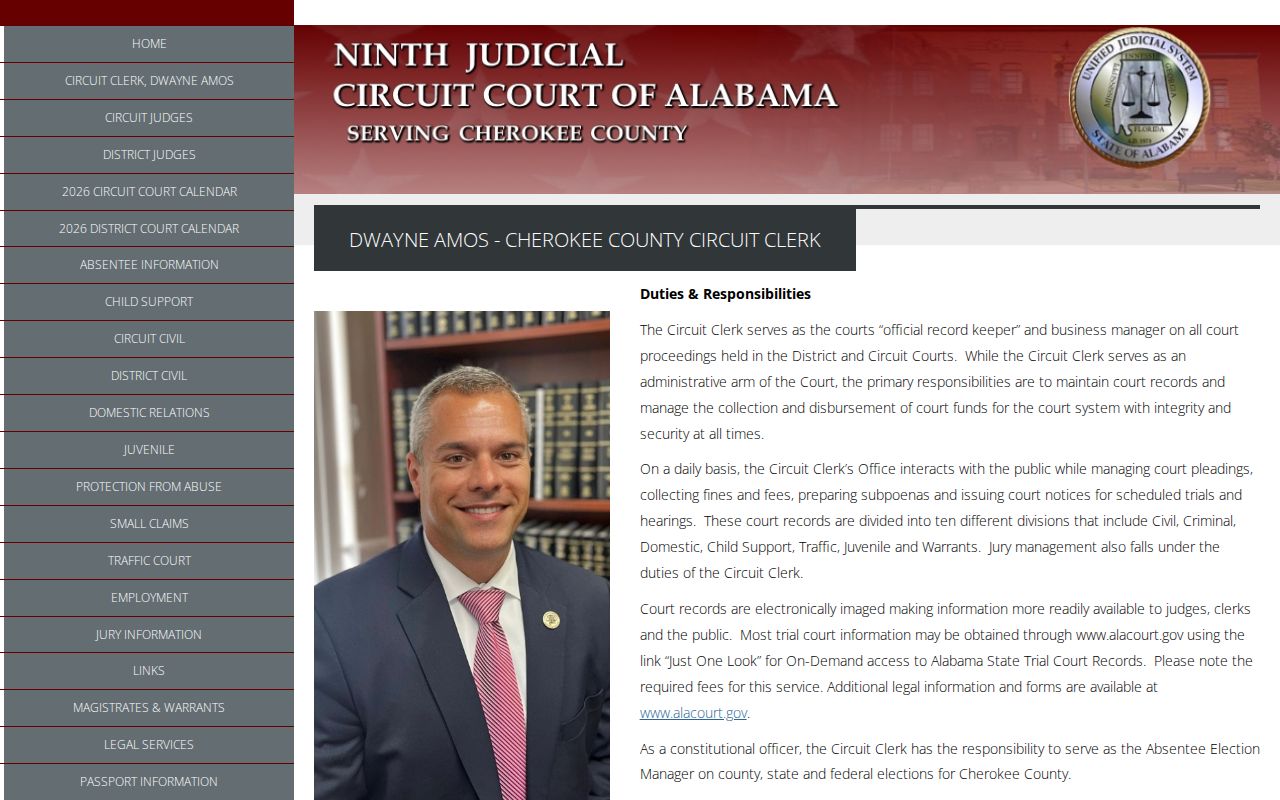
Cherokee County's clerk-linked request form is the way to pull a full public court record. No copy fee or turnaround time is posted, so call before you plan a visit or send payment. Just One Look helps with case-by-case access. It is not a statewide warrant clearance, though, and it will not confirm whether an active warrant exists.